📊 Background: Why Do Officers Use Their Weapons?
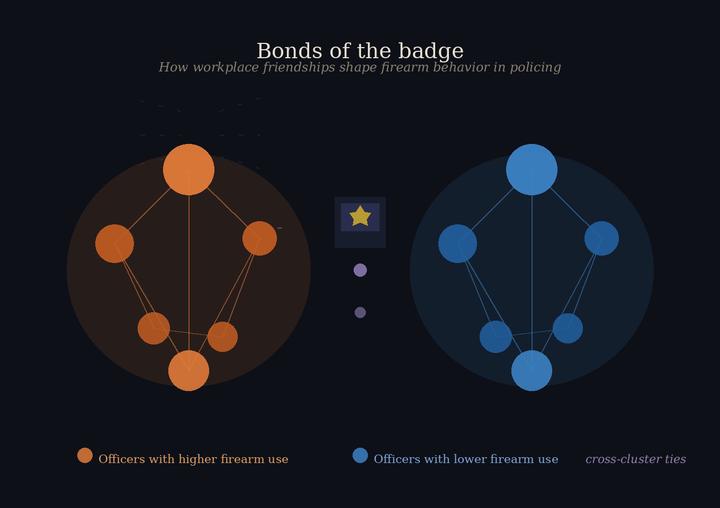
Police shootings have long raised questions about when and why officers use their weapons. Prior research often points to “risky places” (high-crime neighborhoods) or “risky suspects” (armed or threatening individuals). But these explanations overlook a key dimension: who officers know. Emerging evidence suggests that firearm use clusters not just in high-risk situations, but also within close-knit circles of officers.
Ethnographies have shown that peers shape police behavior. In police departments, officers spend long hours together, build trust, and learn informal norms directly from one another. These peer influences can guide decisions in high-stress situations as strongly as formal policies or training. However, few studies have examined how workplace friendships influence decisions to draw or discharge a weapon.
Our study addresses this gap by mapping the friendship networks of over 1,500 officers in a large U.S. department and tracking changes in both friendships and firearm behaviors over time.
🔬 Methods: Mapping Friendship Networks in Policing
We surveyed over 1,500 officers in a large U.S. police department over two years to examine whether workplace friendships shape firearm behaviour. In each wave, officers named up to ten close friends within the department. Using unique identifiers, we linked nominations across respondents to reconstruct the full friendship network, revealing how friendships spanned ranks, units, and assignments. Connecting this network to firearm use showed not only how often each officer used their weapon, but also how their friends’ behaviors compared.
We used Stochastic Actor-Oriented Models to examine two key processes: whether officers tend to befriend colleagues with similar firearm behaviours (selection), and whether they adjust their own firearm use based on their friends’ behaviours (influence). The models controlled for a range of factors, including rank, assignment, sex, race, tenure, threats, and Taser use.
💡 Results: How Police Friendships Shape Firearm Use
We found that firearm behaviours clustered within workplace friendship networks, with officers’ firearm use closely aligning with that of their friends.
First, officers were more likely to form friendships with colleagues who showed similar levels of firearm use. Those who used their weapons more frequently tended to befriend others who did the same, while officers who rarely used firearms clustered together.
Second, even after accounting for this self-selection, there was evidence of peer effects. Officers’ firearm use increased when their friends used firearms more frequently and declined when their friends seldom did.
Beyond peer effects, firearm use was higher among street-level officers with higher citizen contact and lower among those in specialized units. Male officers and recent academy graduates also showed higher rates of firearm use.
🎯 Implications: Managing Peer Influence in Policing
Firearm use spreads through officers’ informal friendships. Because these relationships often develop through shared assignments and transfers, organizational decisions can unintentionally shape where higher-risk behaviors cluster. Departments can proactively address this by pairing officers with colleagues who model restraint, rotating assignments to prevent clusters of firearm-prone officers, and foster mentorships that reinforce accountability. Managing who works and socializes together can help curb risky norms and reduce firearm use.

Marie Ouellet
Assistant Professor
Sadaf Hashimi
Assistant Professor
My research interests include policing and policy, peer influence and crime, and violence prevention and intervention efforts.